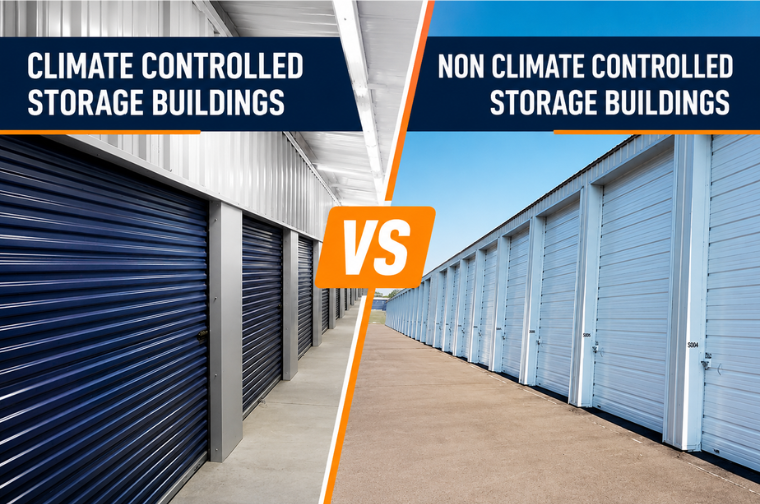
Climate controlled storage and standard storage look nearly identical from the outside. The difference shows up when the temperature drops to 10 degrees in January — or climbs to 103 in July — and whatever is inside has nowhere to go.
Climate controlled storage maintains both temperature and relative humidity within a fixed range year-round — typically 55 to 85 degrees Fahrenheit and 30 to 50 percent relative humidity — regardless of what is happening outside. Standard (non-climate controlled) storage provides no such regulation. The interior temperature tracks the outdoor weather, and humidity levels rise and fall with rain, snow, and seasonal changes.
For anyone building or buying a storage facility, that difference determines which tenant market you can serve, what you can charge per unit, and what happens when a customer stores something sensitive and it comes back damaged. Getting this decision right early saves significant money on retrofits later.
Key Highlights
- Climate controlled storage regulates both temperature (55–85°F) and relative humidity (30–50% RH) year-round
- Standard storage provides no temperature or humidity regulation — interior conditions track the outdoor weather
- Electronics, documents, wood furniture, wine, pharmaceutical products, and artwork require climate control
- Vehicles, construction equipment, and most durable goods do fine in standard storage
- Climate controlled units command higher monthly rents and attract longer-term business tenants
- Most successful facilities offer both — a climate controlled wing and standard drive-up units
- Get a quote on a climate controlled or standard storage building — call (844) 315-3151
Planning a storage facility? Get help comparing standard, climate-controlled, or mixed-use storage building options. Request a free quote or call (844) 315-3151.
What Does Climate Controlled Storage Actually Regulate?
Most people hear “climate controlled” and picture air conditioning. The reality covers more ground than that. A properly built climate controlled storage building actively manages four things: temperature, relative humidity, air quality through filtration, and air circulation through HVAC zone cycling. All four work together.
Temperature alone is not enough. A building can hold 70 degrees all summer while humidity climbs to 80 percent, and the stored contents will still develop mold. The entire system — the HVAC unit, the insulation specification, the vapor barrier, and the building envelope — must work as a unit. If any one of those components is undersized or missing, the regulated climate breaks down.
Temperature Control: What Range Is Required
A climate controlled storage building maintains temperatures between 55 and 85 degrees Fahrenheit throughout the year. That range prevents heat expansion damage in summer and cold-weather brittleness in winter. It also eliminates the freeze-thaw cycles that crack wood joints, split paint, and degrade adhesives. Standard self-storage units in the same climate can swing 30 to 40 degrees within a single day during peak seasons, depending on the building’s construction and orientation.
Some items require tighter tolerances. Wine storage typically targets 55 to 65 degrees. Pharmaceutical samples may require a narrower band defined by the manufacturer. For those applications, the HVAC system needs to be specified and sized for the tighter target range, not the standard 55 to 85 window.
Humidity Control: The Factor Most Operators Miss
Humidity does more cumulative damage to stored goods than temperature in most U.S. climate zones. Mold begins growing above 60 percent relative humidity, often within 24 to 48 hours of exposure in warm conditions. Wood furniture warps and swells when humidity spikes. Electronic circuit boards oxidize and corrode. Paper documents yellow, stick together, and become unreadable. Metal surfaces rust.
A climate controlled building maintains relative humidity between 30 and 50 percent through the HVAC system working in combination with a vapor barrier installed throughout the building envelope. Standard storage buildings have no vapor barrier requirement and no mechanism for controlling moisture. Rain, snowmelt, and seasonal humidity move freely through the structure.
What Standard (Non-Climate Controlled) Storage Does and Does Not Do
Standard storage is not a lesser product. For a large segment of the market, it is exactly the right one. Vehicles, construction equipment, landscaping machinery, outdoor furniture, and most general merchandise tolerate temperature and humidity swings without meaningful damage. A contractor storing a trailer of lumber, pipe, or tools through the winter does not need climate control. Neither does someone keeping a boat on a cradle or a riding mower in the off-season.
Standard storage buildings are less expensive to build, have lower operating costs, and fill quickly because the demand for general storage is broad and consistent. The limitation is clear: no protection against moisture accumulation, mold, condensation, temperature extremes, or the physical changes those forces cause in sensitive materials. That is not a design flaw. It is simply what the building was built to do.
Climate Controlled vs. Non-Climate Controlled Storage — Side by Side
The table below compares the two building types across the factors that matter most for operators deciding which to build and for tenants deciding which to rent.
| Feature | Climate Controlled Storage | Standard (Non-Climate) Storage |
|---|---|---|
| Temperature Regulation | Yes — 55 to 85°F maintained year-round | No — mirrors outdoor temperature |
| Humidity Control | Yes — 30 to 50% RH maintained | No — fluctuates with weather and season |
| Insulation Required | Yes — minimum R-13 walls, R-19 roof recommended | Optional or minimal |
| Vapor Barrier | Required throughout building envelope | Not required |
| HVAC System | Required — sized to building footprint and target range | Not required |
| Best Stored Items | Electronics, documents, furniture, wine, artwork, pharmaceuticals | Vehicles, equipment, durable goods, general merchandise |
| Target Tenant Market | Business inventory, medical, legal, premium residential | Broad general-purpose residential and commercial |
| Monthly Unit Rate | Higher — premium pricing supported by tenant need | Standard market rate for the area |
| Operating Cost | Higher — ongoing HVAC and utility expense | Lower operating overhead |
| Build Cost | Higher — insulation, HVAC, and envelope work adds to project cost | Lower baseline construction cost |
Which Items Require Climate Controlled Storage?
The list covers more categories than most operators anticipate when they start planning a facility. These item types consistently show damage in standard storage across multiple climate zones:
| Item Type | Primary Threat in Standard Storage | What Climate Control Prevents |
|---|---|---|
| Business Records and Documents | Humidity, mold, yellowing, paper fusion | Keeps RH below 50% — prevents degradation and legal unusability |
| Electronics and Server Equipment | Condensation on circuit boards, oxidation, dust accumulation | Stable temperature prevents condensation; filtration limits dust damage |
| Solid Wood Furniture | Warping, joint failure, veneer bubbling, finish cracking | Humidity control stops the expand-contract cycle that cracks wood |
| Wine and Spirits | Heat above 70°F degrades flavor; heat spikes cause cork failure | Consistent 55–65°F range preserves chemistry and cork integrity |
| Artwork and Photography | Canvas warping, photo emulsion separation, paint cracking | Stable environment prevents the physical changes that destroy media |
| Musical Instruments | Joint failure, soundboard cracking, finish blistering outside 45–55% RH | Holds humidity in the range instruments are built to function within |
| Pharmaceutical Products | Temperature deviation from manufacturer storage range | Maintains compliance with labeled storage requirements |
| Metal Tools and Firearms | Surface oxidation and rust from elevated humidity | Low RH prevents oxide formation on bare metal surfaces |
| Fabric, Clothing, and Textiles | Mold, mildew, insect activity in warm humid conditions | Controlled humidity reduces mold risk and insect breeding conditions |
Building for business tenants? We build climate controlled storage buildings for self-storage businesses across the country. Tell us about your project and we’ll help you spec the right building for your market. Get a Quote or call (844) 315-3151.
Cost Difference: Climate Controlled vs. Standard Storage Buildings
Building climate controlled storage costs more than building standard storage. Three sources drive that difference: insulation, HVAC equipment, and ongoing operating cost. None of them are optional — shortcutting any one of the three produces a building that cannot maintain stable conditions.
Proper insulation for a climate controlled building requires a minimum of R-13 in the walls and R-19 or higher in the roof panels. A vapor barrier is required throughout the building envelope. Thermal bridging — the heat transfer that moves through metal framing — must also be addressed. Hat channel framing systems installed between the steel framing and the insulation layer break the thermal bridge and meaningfully improve the building’s ability to hold a regulated climate.
HVAC equipment sizing depends on total square footage, ceiling height, the number and size of access points, and the target temperature range. Undersized systems run continuously, never achieve stable conditions, and fail early. Oversized systems short-cycle, which prevents adequate humidity control even when the temperature setpoint is met. Proper sizing requires an HVAC engineer to calculate the building’s load based on actual dimensions and specifications.
Utility costs for a climate controlled facility run higher than standard storage. The gap varies by climate zone, insulation quality, and building orientation. Operators in the Southeast and Southwest will see higher cooling loads than those in the Midwest or Mountain West. That operating cost is a real line item and needs to be factored into unit pricing from the start.
Helpful planning resources: review storage building door options, metal building roof systems, and storage building financing options before you finalize the building package.
Why Climate Controlled Units Command Higher Rents
Climate controlled units consistently rent at higher monthly rates than standard units in the same facility. The added cost is offset by the revenue premium. Business tenants storing inventory, records, equipment, or regulated products have a specific need for the regulated environment — they are not comparison shopping for the cheapest available unit. They are looking for a facility that can reliably protect what they are storing, and they will pay for that reliability.
Churn is also lower in climate controlled sections. General storage tenants move in and out more frequently. Business tenants with inventory, compliance requirements, or operational equipment tend to stay longer because relocating is disruptive and the alternatives are fewer. Lower turnover means lower vacancy loss and lower leasing overhead over time.
How to Decide Which Type of Storage Building Your Facility Needs
Four factors should drive this decision — in this order.
Your market. A facility in Phoenix, Houston, or Miami will see summer heat that turns an unregulated interior into an oven for months at a time. A facility in a mild Pacific coast climate has a different risk profile. Before choosing, understand what an unregulated building interior actually looks like at the extremes of your local weather pattern. Walk into a standard unit in August and in February and measure the temperature. That is the customer experience you are selling in standard storage.
Your target tenant. Business tenants with compliance needs, valuable inventory, or equipment that cannot be exposed to temperature swings will specifically look for climate control. They will not rent a standard unit as a substitute — they will go to a competitor who offers what they need. If you want that market segment, you need the product they are looking for.
Your unit mix. Most successful facilities offer both. A standard drive-up wing serves the broad residential and contractor market. A climate controlled interior hallway section serves premium tenants. Running both maximizes occupancy across tenant types and allows you to fill the facility from two demand pools instead of one.
Your financing and build budget. Climate controlled construction requires a larger upfront investment. If capital constraints make the full build difficult, starting with a standard facility and adding a climate controlled expansion later is a legitimate and common approach. Our storage building financing options cover the routes available for both scenarios.
Choose Climate Controlled When…
- Your market has extreme summer heat or winter cold
- You are targeting business, medical, or legal tenants
- You want to store electronics, documents, or regulated products
- You need higher per-unit revenue to support the build cost
- You want lower tenant turnover and longer average rentals
- You are building interior hallway-access units
Standard Storage Works When…
- Your primary tenants are storing vehicles, equipment, or durable goods
- You need to minimize initial construction cost
- Your climate is mild with limited temperature extremes
- You are building drive-up units for general residential demand
- You plan to add climate control in a later expansion phase
If you are building a new facility and are not sure which direction fits your market, the best starting point is talking through the project with someone who has built both. Our building specialists have worked on facilities across every climate zone in the country. Call us at (844) 315-3151 and walk through your site, your market, and your budget. We can help you figure out the right building before you commit to a design.
Need layout help before you price the project? Start with our storage building layout ideas, review doors and hallway systems for storage buildings, or request a custom quote.
Related reading: Not sure whether climate control or air conditioning is what you need? See our breakdown of air-conditioned vs. climate-controlled storage buildings for a direct comparison of how the two systems differ in function and cost. If you are planning a mini storage building, we also cover how climate control works within a multi-unit self-storage layout.
Frequently Asked Questions
What is climate controlled storage?
Climate controlled storage is a building where both temperature and relative humidity are actively maintained within a set range year-round, regardless of outdoor weather. Temperature is typically held between 55 and 85 degrees Fahrenheit, and humidity is kept between 30 and 50 percent relative humidity. This protects stored goods from heat damage, moisture, mold growth, condensation, and corrosion — risks that standard storage buildings cannot prevent. Achieving this requires a properly sized HVAC system, adequate R-value insulation, and a vapor barrier installed throughout the building envelope.
Is climate controlled storage more expensive than standard storage?
Yes, both to build and to operate. Building a climate controlled facility requires higher R-value insulation and HVAC equipment, which increases the upfront project cost compared to a standard building of the same size. Monthly rental rates for climate controlled units are also higher than standard units. For operators, the added revenue per unit — driven by premium pricing and lower tenant turnover — typically offsets the higher build and operating cost over the facility’s lifespan.
Do all storage items need climate controlled storage?
Not all items require climate control, but more categories are vulnerable than most owners expect. Electronics, paper documents, wood furniture, musical instruments, wine, artwork, pharmaceutical products, and firearms are consistently damaged by humidity swings and temperature extremes in standard storage. Vehicles, construction equipment, and most durable goods tolerate standard conditions without meaningful damage. The key question is whether the item is sensitive to temperature variance, moisture, or condensation — and over what time period it will be stored.
What humidity level should a climate controlled storage building maintain?
Most climate controlled storage facilities maintain relative humidity between 30 and 50 percent. Below 30 percent, wood and leather can dry, crack, and warp over time. Above 50 percent, the risk of mold growth increases significantly and corrosion on metal surfaces accelerates. Maintaining this range consistently requires both a properly sized HVAC system and a vapor barrier installed throughout the building envelope. Without the vapor barrier, exterior moisture penetrates the wall assembly and undermines the HVAC system’s ability to hold stable humidity levels.
Can a standard storage building be converted to climate controlled?
Yes, but conversion requires adding a properly sized HVAC system and upgrading insulation to meet the required R-values throughout the wall and roof assembly. The building must also be sufficiently airtight for the system to maintain stable conditions — gaps around doors, roof ridges, and utility penetrations all need to be sealed. Conversion projects are most cost-effective when the existing structure is in good condition and large enough to justify the HVAC investment. Call us at (844) 315-3151 to discuss whether your building is a viable candidate for conversion.
The Bottom Line
Climate controlled storage and standard storage serve different markets and different tenant needs. Neither is universally better. The right choice comes down to your climate, your target tenants, your unit design, and your budget — and the most successful facilities typically offer both under the same roof.
Standard storage fills quickly, costs less to build, and requires less operating overhead. Climate controlled storage generates higher per-unit revenue, attracts business tenants with longer rental periods, and opens your facility to the entire market segment that needs environmental protection for what they are storing.
If you are planning a new facility and want help deciding which approach fits your market — or how to structure a mixed-use design — we can help you work through it. Our building specialists have designed and delivered facilities in every climate zone across the country.
Ready to plan your storage facility?
Get a quote on a climate controlled storage building, a standard facility, or a mixed-use design. Our building specialists will help you spec the right building for your market and your budget.
Request a Free Storage Building Quote or call (844) 315-3151.